Cast vs. Fabricated Heat Treat Baskets: Which Is Right for Your Process?
Cast or fabricated? Compare heat treat baskets on weight, strength, thermal shock, cost, and lead time, and find out which one fits your furnace and process.
Quick Answer
Cast heat treat baskets are heavier and more rigid, which makes them a strong fit for heavy loads and long, high-temperature cycles. Fabricated baskets are lighter and more ductile, which makes them better for weight-sensitive loads, frequent cycling, quenching, and custom sizes. The right alloy matters as much as the construction.
Heat treat baskets carry every load through every cycle. The basket you choose affects how many parts fit in a load, how much energy goes into heating metal that isn't product, how often you're replacing baskets, and what each cycle really costs you.
The first decision is construction. When it comes to cast vs. fabricated heat treat baskets, both are proven, both are used across the industry, and neither one is the right answer for every process. Here's how they compare and how to decide.
What's the Difference Between Cast and Fabricated Baskets?
Cast baskets are made by pouring molten heat-resistant alloy into a mold. The result is a one-piece or multi-section basket with thicker, solid sections. Common cast grades for baskets include HT and HU, nickel-chromium alloys built for high-temperature service.
Fabricated baskets are built from wrought material, such as bar, rod, plate, and wire mesh, that's formed and welded together. Rod frame baskets are a common example. Alloy choices typically run from 304 and 316 stainless for lower-temperature and cleaning work up to 330 and Inconel for higher-temperature heat treating.
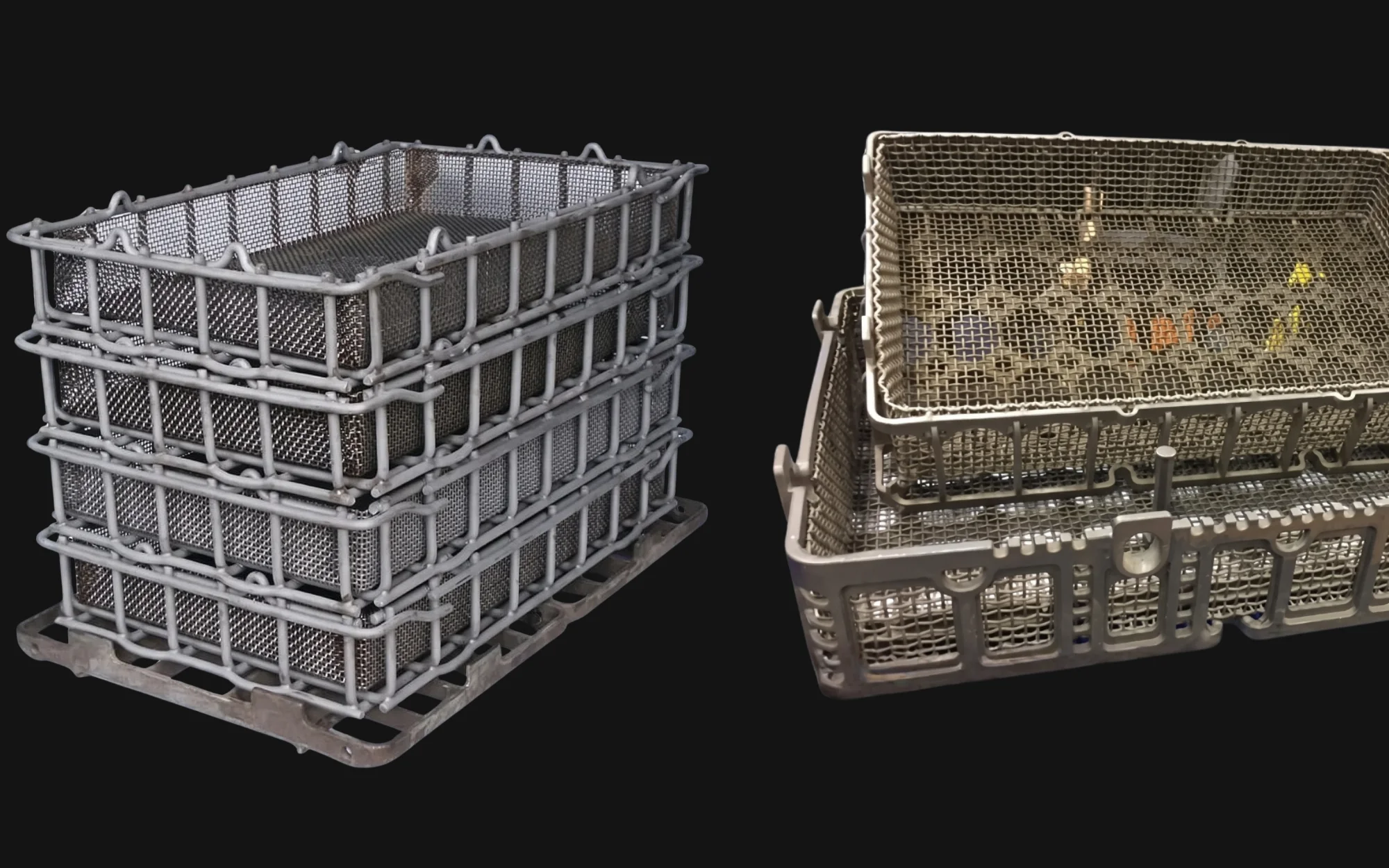
Fabricated 330 rod frame basket with mesh liners and Cast HU heat treat basket
Cast vs. Fabricated at a Glance
Cast Baskets
Fabricated Baskets
Weight
Heavier, more mass to heat every cycle
Lighter, so more of your furnace capacity goes to parts
High-temperature strength
Thick sections resist sagging and distortion under heavy loads
Thinner sections can distort over time at high temperature
Thermal shock
Less ductile, can crack under severe, repeated shock
More ductile, tends to flex rather than crack
Custom designs
New designs need a pattern, which adds cost and lead time
Easy to build to custom sizes without tooling
Repairability
Harder to weld-repair, especially once aged
Damaged sections and mesh can usually be replaced
Best fit
Heavy loads, long high-temperature cycles, standard designs
Heavy, dense loads that would cause a lighter fabricated basket to sag or bow
Long cycles at high temperature, where rigidity and resistance to creep matter most
Standard sizes and designs, where an existing pattern means no tooling cost
Maximum service life, when you can accept the extra weight in exchange for a basket that holds its shape longer
If cast baskets are going into quench service, alloy selection matters even more, and higher-nickel grades are generally the better choice for handling repeated thermal shock.
When Fabricated Baskets Make Sense
Weight-sensitive operations. If you're up against furnace load limits or handling limits, every pound of basket is a pound of parts you can't run. Lighter baskets also take less energy to heat.
Frequent cycling or fast quenching, where ductility helps the basket survive rapid temperature changes
Custom sizes and short runs, where building a pattern doesn't make sense
Cleaning, pickling, and plating lines, where stainless grades handle the chemical environment at lower temperatures
Small parts that need fine mesh to keep them from falling through
The Hybrid Option: Rigid Baskets With Mesh Liners
You don't always have to choose one or the other. A common approach pairs a rigid outer basket, either cast or rod frame, with fabricated wire mesh liners or screens that hold smaller parts. The outer basket carries the load and keeps its shape. The liner keeps small parts contained and can be replaced on its own as it wears, without replacing the whole basket.
Recent Allegheny Alloy builds include HU and HT cast baskets with mesh liners and 330 rod frame baskets with liners, in sizes ranging from 18" x 24" up to 36" x 48".
Alloy Matters as Much as Construction
Cast or fabricated is only half the decision. The alloy has to match your temperature, atmosphere, and environment. A basket going through carburizing needs different properties than one used for annealing, and a basket running through pickling, plating, or cleaning has to hold up to chemical attack as well as heat. For a deeper look, see our guide on how to choose the right heat-resistant alloy.
Compare Cost Per Cycle, Not Price Per Basket
It's easy to compare baskets on purchase price. The more useful number is cost per cycle: what the basket costs divided by how many cycles it lasts. A cheaper basket that needs replacing twice as often isn't actually cheaper.
Weight belongs in that math too. Every pound of basket gets heated every cycle, so a heavier basket quietly adds energy cost and takes up capacity that could be running parts. When comparing options, look at expected service life, weight, and what a basket failure mid-run really costs you in scrapped parts and downtime.
Signs It's Time to Replace Your Baskets
Warping that keeps baskets from stacking or sitting level
Cracks in castings or at welds
Sagging bottoms or bowed sides
Torn or worn mesh that lets parts slip through
Distortion that's starting to affect how parts heat or quench
Running a basket past these points risks more than the basket. A failure inside the furnace can mean scrapped parts and an unplanned shutdown.
What to Have Ready Before You Request a Quote
The fastest way to the right basket is giving your supplier the full picture up front. Before you reach out, pull together:
Basket dimensions and any fit constraints from your furnace or handling equipment
Typical load weight and part size, including the smallest parts that need to be contained
Process and temperature, such as carburizing, annealing, or neutral hardening, and your typical operating temperature
Quench type, if any, and how often the basket cycles
Current basket life, if you're replacing an existing basket, and how the old ones failed
Drawings or photos of the basket you're using now
With that in hand, a good supplier can tell you quickly whether cast, fabricated, or a combination makes the most sense.
Worn-out baskets still have value. Our scrap buy-back program purchases heat-resistant alloys, and eligible scrap value can be applied toward your next order.
Not sure which is the better fit for your process?Request a quote with your load size, weight, and process details, and we'll help you work it out.
Frequently Asked Questions
Are cast baskets stronger than fabricated baskets?
At high temperature under heavy load, thick cast sections generally resist sagging and distortion better. Fabricated baskets are usually more ductile, so they handle thermal shock better. Which one is stronger depends on the kind of stress your basket actually sees.
What alloys are heat treat baskets made from?
Cast baskets are commonly made from heat-resistant cast grades like HT and HU. Fabricated baskets and liners are often made from 304 or 316 stainless for lower-temperature and cleaning applications, and 330 or Inconel for higher-temperature heat treating. The right choice depends on temperature, atmosphere, and chemical exposure.
Can fabricated baskets be used for quenching?
Yes. Fabricated baskets are widely used in quench applications because their ductility helps them tolerate rapid temperature changes. Alloy and design still matter, since quenching is one of the hardest things a basket goes through.
Can a damaged basket be repaired?
Often, yes, especially fabricated baskets, where damaged sections or mesh can be cut out and replaced. Cast baskets are harder to repair, and heavily aged material may not weld well. It depends on the condition of the basket.
Do you make custom basket sizes?
Yes. We build both cast and fabricated baskets in a wide range of sizes and alloys. Recent builds range from 18" x 24" up to 36" x 48". Request a quote with your dimensions.
A real engineer carefully reviews every request and responds with a full, detailed itemised breakdown — no automated pricing, no hidden fees, no surprises.